Have you ever looked at a plastic bottle cap, a car dashboard trim, or a medical syringe and wondered how it was made? Most likely, it was injection molded. Injection molding is the most common manufacturing process for producing high‑volume plastic parts — and for good reason. It’s fast, repeatable, and capable of creating complex geometries with tight tolerances.
The Basic Cycle
Injection molding machines operate on a simple cycle: clamp, inject, cool, eject.
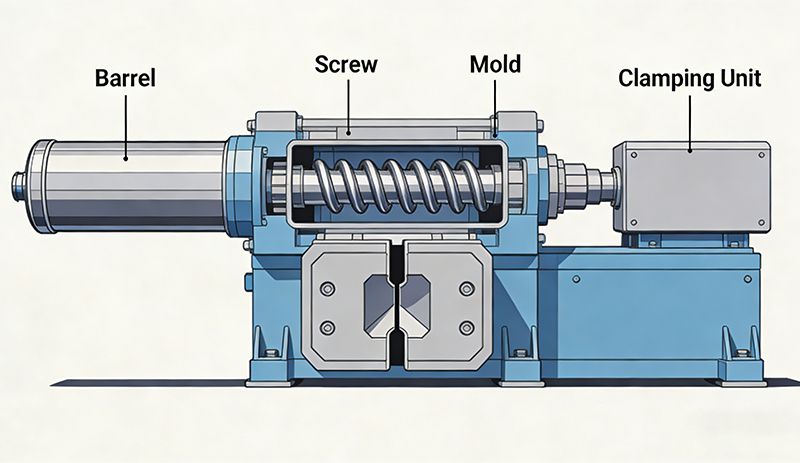
Clamp – The two halves of the mold are securely closed by the clamping unit. Clamping force must be sufficient to keep the mold closed during injection.
Inject – Plastic pellets (thermoplastics) are fed from a hopper into a heated barrel. A rotating screw pushes the molten plastic forward, injecting it into the mold cavity under high pressure (up to 30,000 psi).
Cool – The plastic cools and solidifies inside the mold. Cooling time depends on wall thickness and material type.
Eject – The mold opens, and ejector pins push the finished part out. The cycle then repeats — typically every 15 to 60 seconds.
Why It’s So Efficient
Once the mold is made (a one‑time investment), per‑part cost drops dramatically. Injection molding can produce millions of identical parts with minimal variation. Automation — including robots for part removal and vision systems for inspection — further reduces labor costs and human error.
What We Do at MEITU
At MEITU, we push injection molding further. Our all‑electric machines achieve ±0.01 mm precision, ideal for micro‑components. We also offer multi‑material molding (overmolding, insert molding) to combine plastics with rubber or metal in a single cycle. And because we design and build our own molds in‑house, we control quality from the very first cavity.
Is Injection Molding Right for Your Product?
If you need 1,000+ parts with consistent quality, complex shapes, and tight tolerances, injection molding is likely your best choice. Contact our engineering team — we’ll review your design and recommend the most cost‑effective approach.